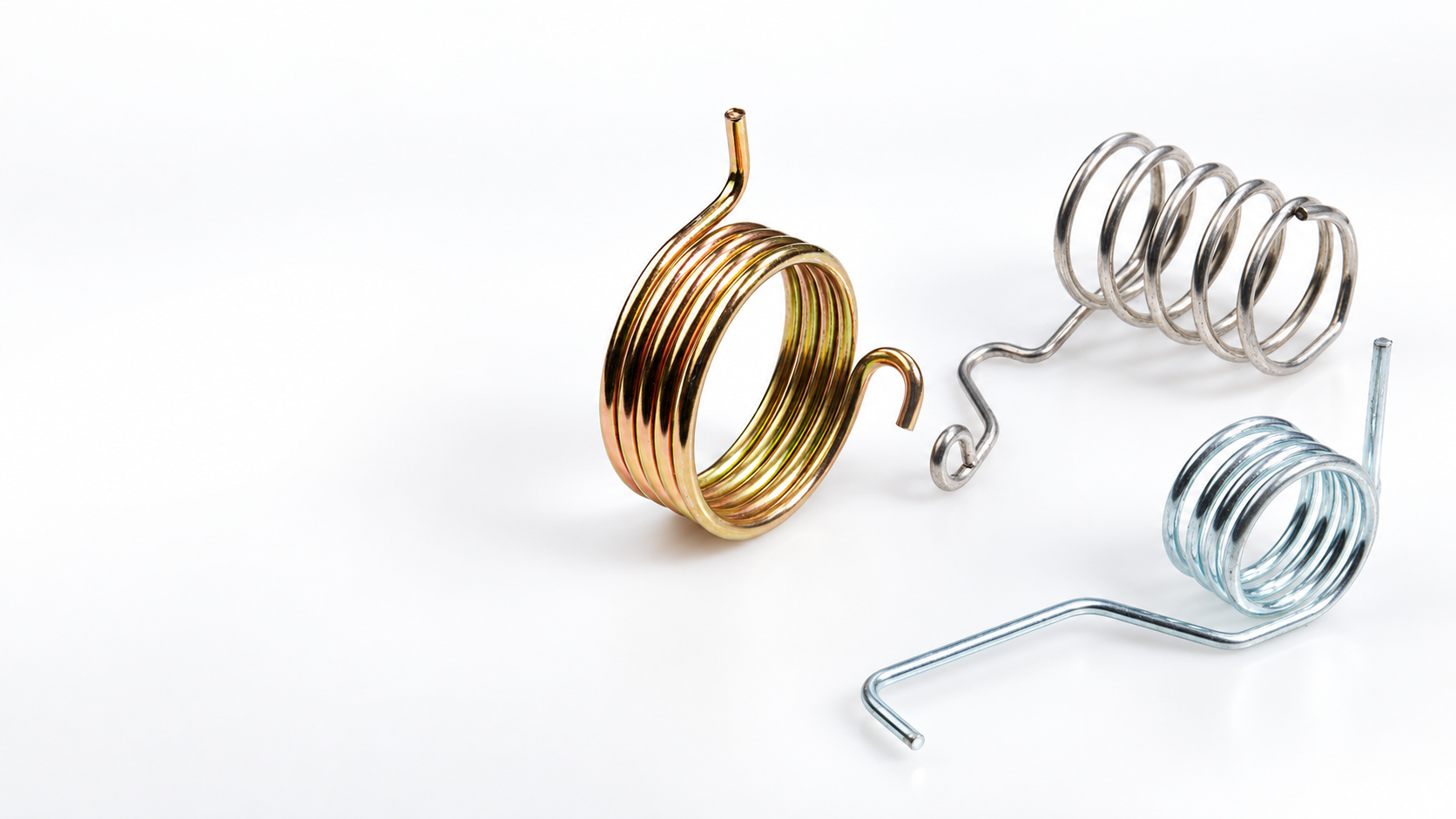
Engineers are often looking for what is technically called a torsion spring when they search for a torque spring. The two terms are frequently used to describe the same basic type of spring: a component designed to store energy through twisting and produce torque as it moves through an angle.
At HyTech Spring and Machine Corp., we work with engineers and manufacturers developing springs for rotating, hinging, clamping and return-motion applications. Understanding the terminology and the basic design requirements can make it easier to determine whether a torsion spring fits the application.
What Is a Torque Spring?
A torque spring is designed to produce rotational force, or torque. A torsion spring is typically wound into a coil and operates by twisting around its axis unlike a compression spring, which is loaded along its axis.
As the spring rotates away from its unloaded position, it stores energy. When the applied force is released, the spring produces torque as it moves back toward its original position.
Three terms are particularly important when discussing torsion springs: torque, load and angular deflection. Torque refers to the rotational force produced by the spring. Load describes the force applied to the spring legs, while angular deflection refers to how far the spring rotates from its starting position. These factors are related, but they are not interchangeable when developing a spring design.
Torque Springs vs. Torsion Springs
For most engineering applications, there is not a separate category of spring called a “torque spring” that is fundamentally different from a torsion spring. Torque spring is commonly used as a search term or general description, while torsion spring is the more common engineering term.
Using the technical term when communicating with a spring manufacturer can help clarify what type of component you need. However, if your initial search starts with “torque spring,” you are generally looking in the right direction when the application requires rotational force.
Common Applications
Torsion springs are used in many mechanisms where controlled rotational movement is needed.
Common applications include:
- Hinges and access panels
- Latches and levers
- Medical-device mechanisms
- Electronic assemblies
- Automotive components
- Return and positioning mechanisms
The spring may provide a return force, hold a component in position or counteract another force within an assembly. The required spring characteristics depend on how the mechanism moves and how much torque it needs.
Important Design Considerations
Several dimensions and operating requirements need to be considered when developing a torsion spring. These include the required torque, working angle, coil diameter, wire diameter and number of active coils.
The leg length and orientation also affect how the spring connects with surrounding components. The direction of winding matters as well because a torsion spring is designed to operate in a specific winding direction.
The operating environment should also be considered. Temperature, exposure to corrosive substances, sterilization requirements and electrical considerations can influence material selection and spring design. Expected cycle life is another important factor, particularly when the spring will repeatedly move throughout the life of the product.
Material Selection
The material used for a torsion spring depends on the requirements of the application. Materials commonly considered include music wire, stainless steel and specialty alloys.
Music wire can be used in applications where its mechanical properties fit the operating conditions. Stainless steel may be considered where corrosion resistance is needed. Specialty alloys can be appropriate when an application has particular temperature, corrosion or electrical requirements.
The material should be selected alongside the spring’s dimensions and operating conditions rather than as a separate decision.
Why Custom Manufacturing Matters
A standard spring may not fit every mechanism. Limited space, unusual leg configurations, specific winding requirements or particular torque and angular-deflection requirements can call for a spring developed around the assembly.
Bringing the spring manufacturer into the design process early can help identify the information needed to develop the component. It also gives engineers an opportunity to discuss packaging constraints and operating requirements before the spring becomes part of a finalized assembly.
At HyTech, we support spring development for applications requiring different configurations and performance characteristics. Our Custom Spring Products, Micro-Components and Industries Served pages provide more information about the types of components we manufacture.
Information Needed for a Quote
When requesting a torsion spring quote, provide as much information as possible, including:
- Drawing or CAD model
- Material requirements
- Coil and wire dimensions
- Required torque
- Working angle
- Expected cycle life
- Operating environment
- Prototype and production quantities
These details give us a starting point for evaluating the spring requirements and discussing the appropriate design.
If you are developing a rotating, hinging, clamping or return-motion mechanism, contact HyTech with your drawing or application requirements to discuss a custom torsion-spring solution.