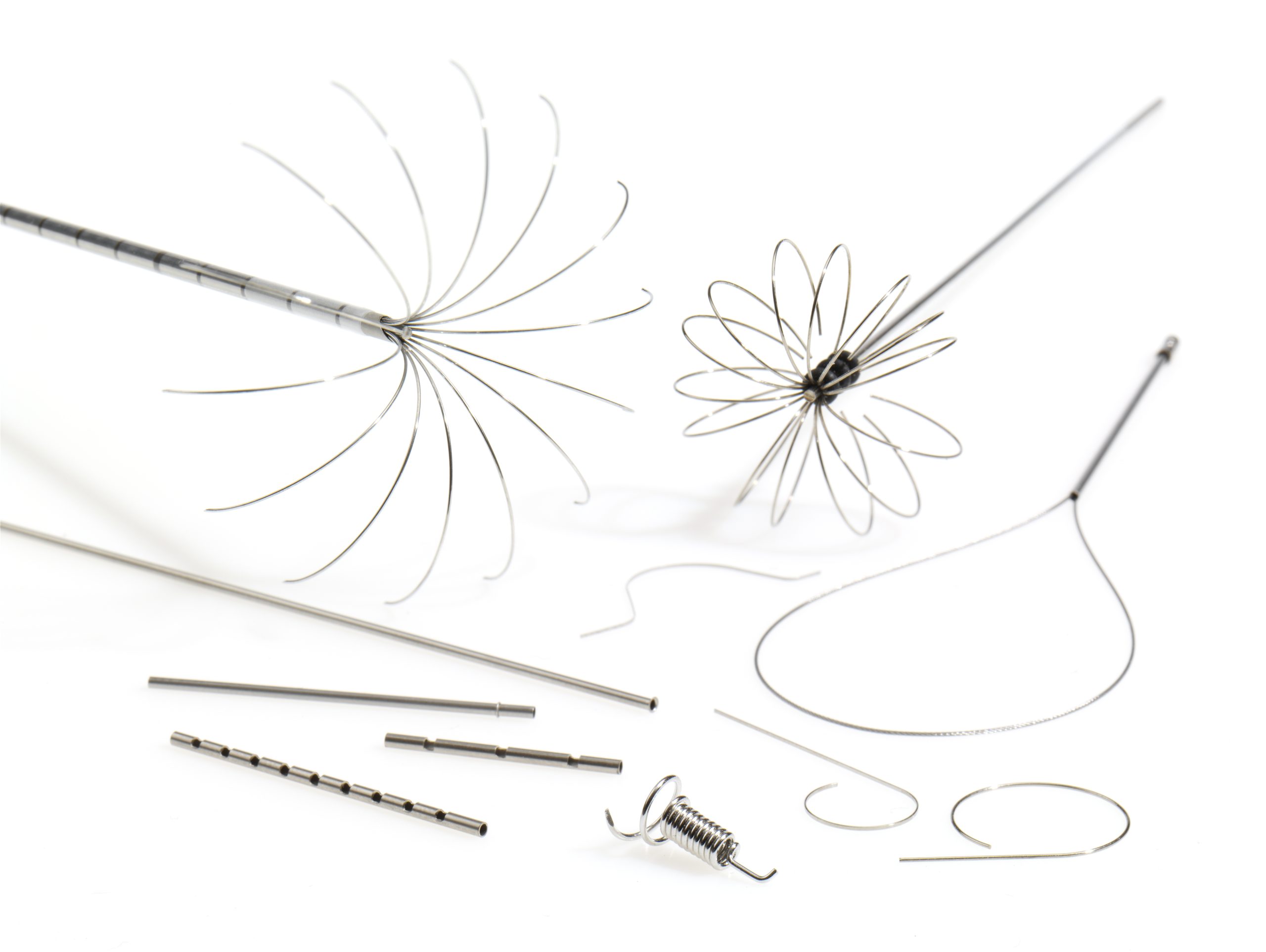
When we work with medical-device engineers on a nitinol spring, the material is only one part of the design discussion. Nitinol is a nickel-titanium alloy known for shape-memory and superelastic behavior. Depending on its alloy condition and processing, a nitinol component can return toward a defined shape after deformation or accommodate substantial movement and recover its original form.
The way nitinol behaves depends on more than the material name. Transformation temperature, processing, spring geometry, wire diameter and the device’s operating temperature all affect how the finished spring performs.
Why Medical-Device Engineers Consider Nitinol
Nitinol can be useful when a device needs a small spring that can accommodate repeated movement or substantial deformation. Its material behavior can allow designers to work with compact spring geometries while retaining useful force and movement characteristics.
Nitinol also offers corrosion resistance and can be considered for applications where the component needs to withstand repeated bending or movement. HyTech manufactures miniature springs, wireforms and medical micro-components, including components used in medical equipment and minimally invasive device applications.
Potential applications include catheter-related assemblies, guidewire or delivery-system components, actuation mechanisms, retention or deployment features and small surgical or diagnostic-device assemblies. Material suitability depends on the complete device design and intended use.
Nitinol Spring Design Considerations
Before we manufacture a nitinol spring, we need to understand what the spring must do in the finished device.
Force and deflection requirements are a starting point. We also need to consider transformation temperature, expected cycle count, wire diameter, coil diameter, pitch, number of active coils and overall dimensions.
Surface condition matters as well. Small surface features or damage can affect how a miniature spring behaves during repeated movement, so the manufacturing process and any secondary operations need to be considered during design.
The interaction between the spring and surrounding components also matters. A spring may need to move through a constrained space, contact another component or provide a specific force at a particular position. Those conditions should be understood before production begins.
Manufacturing Challenges With Nitinol
Nitinol does not behave exactly like conventional spring wire, so manufacturing requires attention to material behavior and processing conditions.
Small spring geometries can make dimensional control more difficult, while springback and shape-setting behavior can affect the finished coil. We also need to consider how forming and subsequent processing affect the spring’s dimensions and surface condition.
At HyTech, we manufacture miniature springs and micro wire components for medical applications. Our spring manufacturing capabilities include small wire diameters and our engineering team can evaluate spring designs for characteristics such as load, free length, coil count and cycle life.
Prototyping and Validation
A drawing alone does not always tell us how a nitinol spring will behave inside a device. Testing under representative application conditions can help identify design changes before a component moves into larger production quantities.
Depending on the project, evaluation may include dimensional inspection, force and deflection testing, functional testing and cycle testing. The appropriate methods depend on the spring and the requirements of the finished device.
We recommend involving manufacturing early when a nitinol spring is still being developed. That gives our team an opportunity to review the spring geometry, material requirements, production quantities and inspection needs before the design is locked in.
What to Provide Us
When you contact HyTech about a nitinol spring, useful project information includes:
- Drawing or 3D model
- Intended application
- Wire size
- Required force or motion
- Operating temperature
- Expected cycle life
- Surface and cleanliness requirements
- Prototype and production quantities
The more we understand about how the spring will function, the better we can evaluate the manufacturing requirements around it.
HyTech Spring and Machine manufactures custom springs, micro wireforms and medical components from its facility in Plainwell, Michigan. We are ISO 9001:2015, AS9100 and IATF 16949:2016 certified and we support medical manufacturing along with aerospace, automotive and electronics applications.
Discuss your nitinol spring design and performance requirements with HyTech’s engineering team.