If you work in medical device development, you already know that the push toward minimally invasive procedures has fundamentally changed what’s being asked of component manufacturers. Considering the precision and complexity required, sourcing a reliable medical manufacturer for such products can be a challenge in itself.
Whether we’re producing catheters, stent delivery systems, neurovascular microcatheters, and robotic surgical instruments all share one common demand: they need components that are smaller, more flexible, and more precisely engineered than ever before.
That’s where laser cut hypotubes come in, a product specialty in which HyTech Spring & Machine has developed deep, hands-on expertise.
What Makes Flexible Hypotubes So Challenging to Manufacture?
Hypotubes are thin-walled metal tubes, often stainless steel or nitinol, used as the structural backbone of minimally invasive devices. A well-designed hypotube must simultaneously deliver flexibility, pushability, torque transmission, kink resistance, and structural integrity. That’s a lot to ask of a component that may have an outer diameter as small as 0.009 inches.
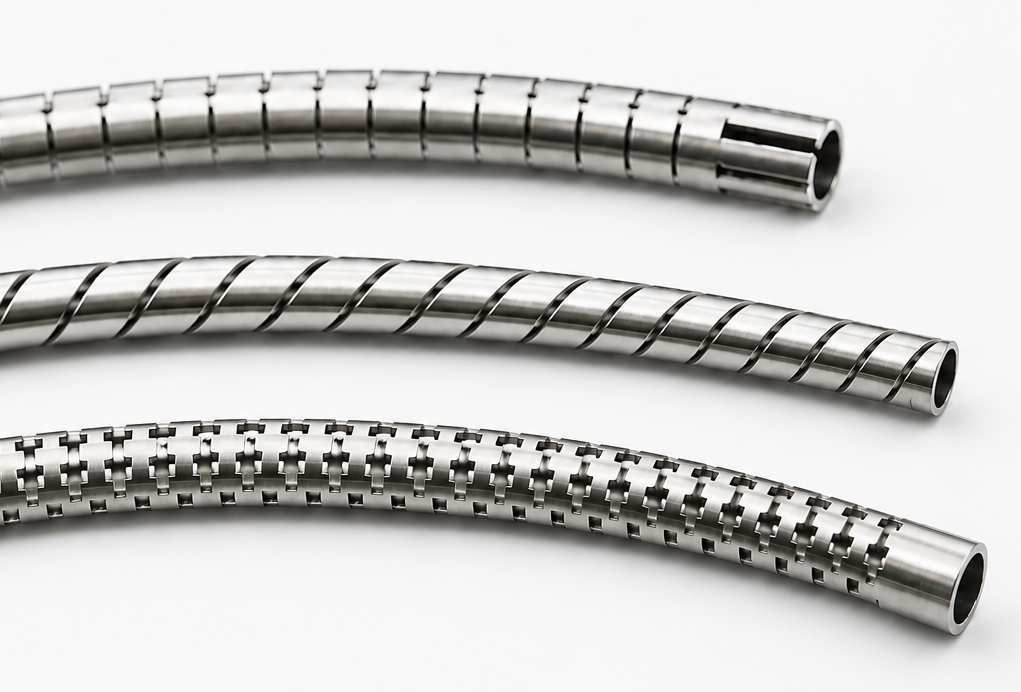
The key to achieving all of those characteristics in a single component is the laser cut pattern applied to the tube wall. By selectively removing material in precise helical, interrupted, or lattice-style patterns, we can fundamentally alter how the tube behaves under stress. Tighter slot spacing increases flexibility but reduces pushability. Wider kerf widths affect torque response.
Essentially, every design parameter is a careful balancing act, and it all starts with the precision of the laser cutting process itself.
Why Laser Cutting is the Right Process for Hypotubes
Conventional mechanical machining simply cannot keep pace with what flexible hypotube manufacturing requires. Physical cutting tools apply pressure to the workpiece, which introduces mechanical stress and deformation to thin-walled tubing. On materials like nitinol, that kind of contact can actually compromise the shape-memory and superelastic properties the device depends on.
Laser cutting is a non-contact process. A focused laser beam ablates or vaporizes material without ever touching the tube wall under pressure. As we’ve covered in our previous blog on laser cutting and laser ablation for complex medical device features, this approach minimizes mechanical stress, dramatically reduces the heat-affected zone (HAZ), and eliminates the tool wear that degrades cut quality over time.
The result is consistent, repeatable precision across thousands of parts, which is exactly what FDA-regulated medical manufacturing demands.
Our laser systems can achieve cutting accuracies down to plus or minus 0.005 mm (5 microns), with slot widths as narrow as 15 to 30 microns. That level of fine-feature capability is what makes intricate flexibility patterns possible on tubes with wall thicknesses measured in hundredths of a millimeter.
HyTech’s Capabilities for Flexible Hypotube Components:
At HyTech, we’ve invested in laser cutting technology and process development that specifically addresses the challenges of flexible hypotube manufacturing. Our capabilities include:
- Laser tube cutting on stainless steel, nitinol, and other medical-grade alloys
- Custom slot patterns, including helical, interrupted helical, and lattice geometries engineered to your flexibility and torque specifications
- Tube outer diameters down to 0.009 inches with tight wall thickness tolerances
- Non-contact processing that preserves material properties in sensitive alloys like nitinol
- Minimized heat-affected zones to protect biocompatibility and mechanical performance
- Secondary operations including electropolishing and passivation to meet FDA surface and biocompatibility standards
For a deeper technical look at our laser cutting process and equipment, see our previous blog on maintaining precision in medical-grade needle tubing that walks through the technical specifics of how we achieve micron-level tolerances on hypotube components.
Medical-Grade Precision and Quality: AS9100:D Certification
Beyond the laser cutting process itself, HyTech’s broader manufacturing capabilities mean we can support your hypotube project across the full component lifecycle. From prototype development and design-for-manufacturability feedback to high-volume production with documented process controls, our ISO 9001:2015 and AS9100:D certifications reflect the quality management infrastructure behind every part we ship.
Partnering with HyTech: Experts in Producing Minimally Invasive Device Components
The medical device industry’s shift toward smaller, more navigable delivery systems is not slowing down. If your development team is working on a catheter assembly, a stent delivery platform, or any minimally invasive instrument that depends on flexible tubular components, we’d welcome the chance to discuss how our laser cutting capabilities can support your program.