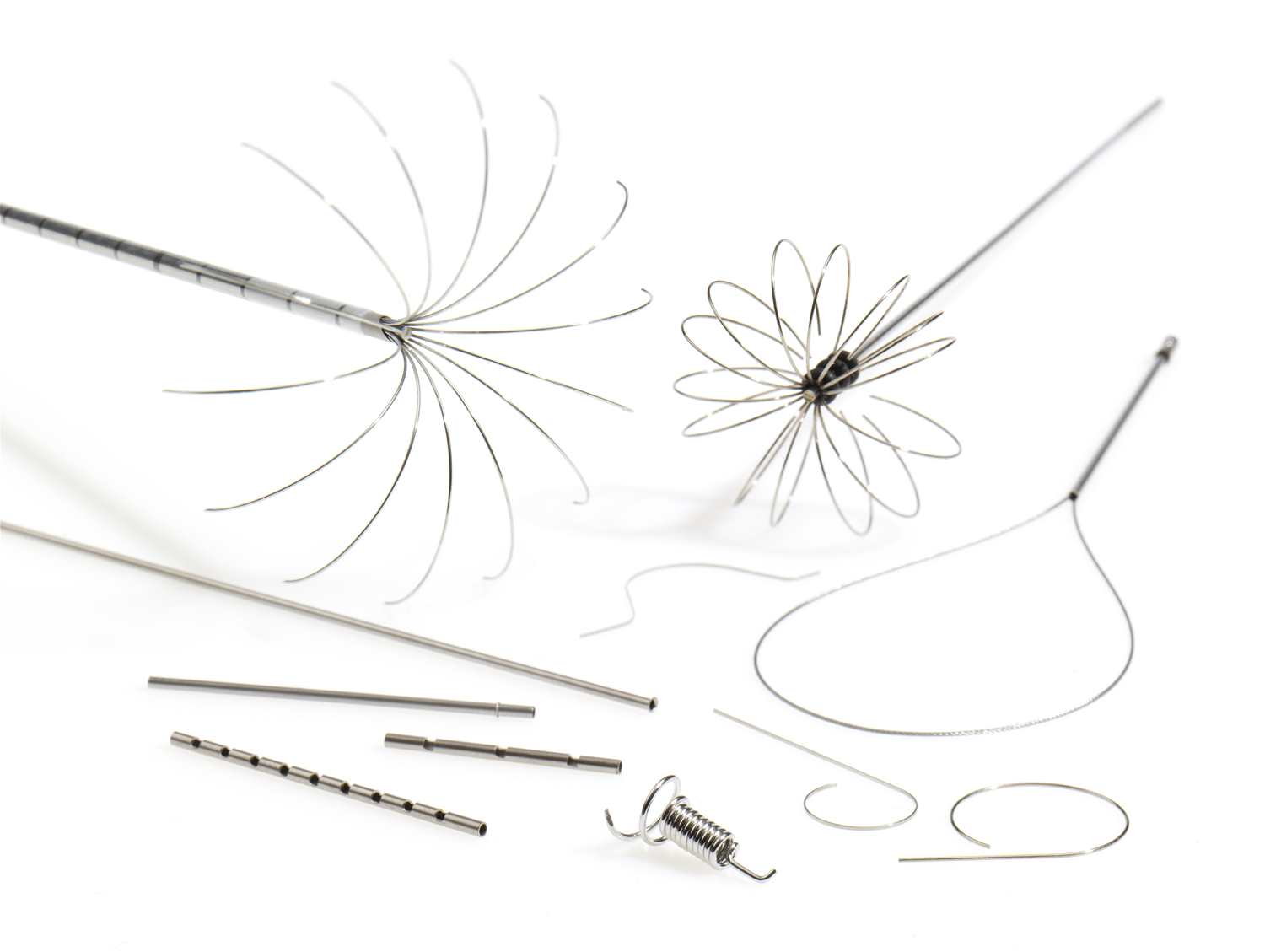
Micro wire forms represent the intersection of precision engineering and medical innovation, enabling the minimally invasive procedures that define modern healthcare. At the micron scale, components must deliver uncompromising performance in flexibility, conductivity, and reliability while navigating the body’s most challenging anatomical pathways.
From catheter reinforcement coils that resist kinking to nitinol guidewires that navigate complex pathways, micro wire forms are crucial components within much of today’s advanced medical device technology. Backed by more than 35 years of precision micro-manufacturing expertise and recognized certifications in medical manufacturing, HyTech Spring & Machine takes our role extremely seriously in producing these critical, potentially life-saving medical components.
Catheter Components: Precision Meets Flexible Rigidity
Catheters represent one of the most critical applications for precision micro wire forms. These slender, tubular medical devices must balance seemingly contradictory requirements: the flexibility to navigate complex vascular pathways combined with sufficient rigidity to resist crushing and kinking during deployment. The solution lies in helical coil reinforcement, where precision-engineered wire coils are embedded within catheter shafts to provide what industry experts call “flexible rigidity.”
Reinforcement coils in catheters play two crucial roles. First, they significantly enhance crush resistance by exerting controlled external pressure on tube walls, maintaining device integrity under the mechanical stresses of minimally invasive procedures. Second, they preserve the flexibility necessary for the device to navigate the body’s intricate vascular networks, including narrow passages that may have internal diameters less than 5mm. The coil design (wire material selection along with wire diameter, pitch, and stiffness) is meticulously engineered to achieve the specific balance of flexibility and pushability required for each specific clinical application.
Beyond reinforcement structures, micro wires also function as conductive pathways within catheter systems. These ultra-fine wires, with diameters between 0.001 and 0.003 inches, are individually insulated to transport electrical energy down the device length for diagnostic or therapeutic functions. (Learn more about Ultra-Fine Wire Coiling and Micro Manufacturing.)
As discussed in our previous blog article on laser cutting and laser welding in medical manufacturing, the precision required for these components demands advanced fabrication techniques that can maintain tolerances in the sub-micron range.
Nitinol Wire Forms: Shape-Memory Innovation
Nitinol (nickel-titanium) wire forms have transformed medical device design through their unique combination of superelasticity and shape-memory properties. You can learn more about nitinol’s unique physical properties in our previous blog: The Material Advantages of Nitinol vs. Stainless Steel.
Suffice it to say, nitinol superelastic shape-memory properties have helped revolutionize many medical wire forms, from stents to guidewires to specialized diagnostic devices. Unlike traditional stainless steel, nitinol can be compressed into a much smaller profile for delivery through a catheter, then expand to its original shape once positioned within the body, all without permanent deformation.
Guidewires represent another major application where nitinol’s unique properties excel. The material’s combination of flexibility and kink resistance allows surgeons to reach otherwise inaccessible lesions and vessel segments through minimally invasive procedures. The super-elastic nature of nitinol guidewires enables them to follow tortuous anatomical paths while maintaining the ability to rotate smoothly, which has made these components the industry standard for many minimally interventional procedures.
MEMS and Sensor Integration: The Next Frontier
Micro-electro-mechanical systems (MEMS) are an emerging frontier in medical device miniaturization. Applications span across the industry, from smart surgical instruments to advanced diagnostic sensors to implantable devices such as drug-delivery systems. MEMS technology likewise enables the integration of sensing capabilities directly into surgical tools, creating smart instruments that provide physicians with real-time feedback during complex procedures. For example, tactile sensors integrated into forceps and similar surgical tools are increasingly used.
The materials used in MEMS applications frequently include ultra-fine wires and precision-engineered metal structures. Advanced medical devices such as these are further driving the industry forward, demanding even greater innovation from manufacturers to achieve precision and repeatability at the tiniest scales.
Common Medical Micro Wire Forms Manufactured at HyTech Spring & Machine:
- Micro springs for drug-delivery pens, insulin pumps, and inhalers
- Guidewire coils used in minimally invasive cardiovascular and neurovascular procedures
- Catheter reinforcement wire forms that provide torque control and kink resistance
- Retention clips and locking mechanisms for surgical instruments and laparoscopic tools
- Stent scaffolding elements and micro-support structures for implantable devices
- Lead frames and conductor wire forms for pacemakers and neuro-stimulators
- Precision wire loops and snares for endoscopic retrieval and tissue removal
- Micro wire hooks and anchors used in orthopedic fixation or suture-management systems
- Electrode wire forms for diagnostic sensors, wearables, and implantable monitors
- Alignment pins, linkage forms, and micro brackets for handheld diagnostic devices
- Miniature torsion springs for pump actuation and robotic surgical tools
- Micro wire frames for diagnostic imaging components and optical assemblies
HyTech: Delivering Precision at the Smallest Scales
The medical device industry’s continued advancement depends on manufacturing partners who combine deep technical expertise with unwavering commitment to quality. At HyTech Spring & Machine, our three-plus decades of experience in precision forming, coupled with our recognized certifications and advanced manufacturing capabilities, position us to support the next generation of life-saving medical devices.
Whether your application requires custom micro coils, precision wire forms, or complex multi-functional assemblies, the principles remain constant: precision engineering, quality assurance, and a partnership approach to solving your most challenging manufacturing requirements.